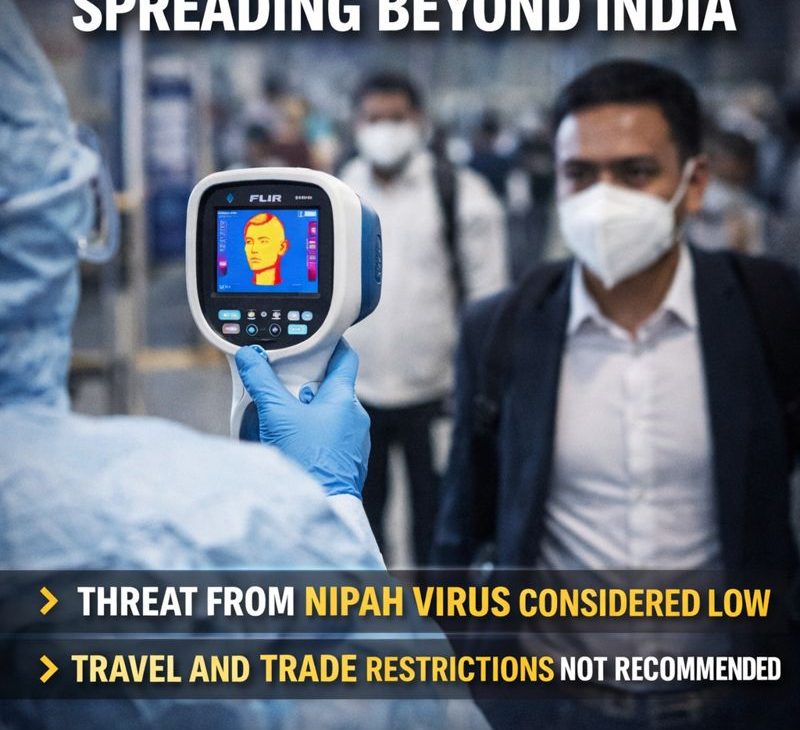
The World Health Organization (WHO) has stated that the risk of the deadly Nipah virus spreading from India is low, following the confirmation of two infections in the country. The WHO has also clarified that there is no need for travel or trade restrictions at this stage.
Asian Countries Tighten Airport Screenings
Countries including Hong Kong, Malaysia, Singapore, Thailand, and Vietnam have enhanced airport health screenings to prevent potential spread after India reported cases.
“The risk of further spread from these two cases is low,” the WHO told Reuters on Friday. The agency highlighted that India has the capacity to contain outbreaks effectively and that there is no evidence of increased human-to-human transmission.
How Nipah Virus Spreads
The Nipah virus is primarily carried by fruit bats and certain animals, including pigs. It can infect humans through:
-
Direct contact with infected bats
-
Consumption of contaminated fruit or produce
Person-to-person transmission is rare and usually requires prolonged close contact with infected individuals. Small outbreaks occasionally occur, but risk to the general population remains low, according to virologists.
Severity and Symptoms
The virus can cause fever and brain inflammation and has a fatality rate of 40% to 75%. There is currently no licensed cure, though vaccines are under development and being tested.
The WHO classifies Nipah as a priority pathogen due to:
-
High fatality rates
-
Lack of approved vaccines or treatments
-
Potential to mutate into a more transmissible variant
Nipah in India
The two health workers infected in West Bengal in late December are receiving treatment in hospitals. India reports sporadic Nipah cases, especially in Kerala, considered a high-risk region since the virus first emerged there in 2018.
This outbreak marks the seventh documented in India and the third in West Bengal, where previous outbreaks occurred in 2001 and 2007 near the Bangladesh border. Neighboring Bangladesh reports annual Nipah outbreaks, the WHO added.