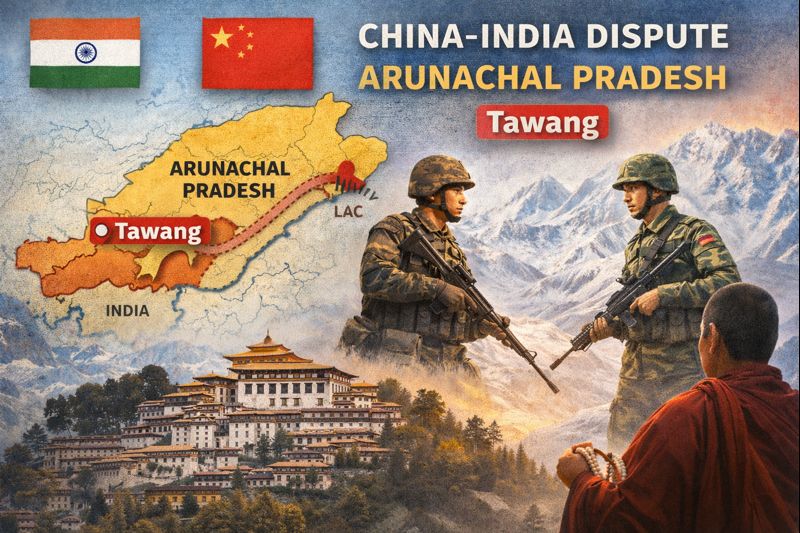
Indian Citizen Detained Over Arunachal Pradesh Birthplace
Late last month, Prema Thongdok, an Indian citizen traveling from London to Japan, was detained for 18 hours in Shanghai. Chinese officials claimed her passport was invalid because it listed her birthplace as Arunachal Pradesh, which China claims as part of its territory. She was also told that she is not Indian but Chinese, preventing her from continuing her journey to Japan.
While the incident did not receive major media attention, it reflects ongoing tensions between China and India over Arunachal Pradesh. Relations between the two nations, which have multiple territorial disputes, had slightly improved in recent years.
China’s Claim Over Arunachal Pradesh
China refers to Arunachal Pradesh as Zangnan, or South Tibet, rejecting the McMahon Line, the northern border established by Britain and Tibet in 1914. Beijing considers the border agreement illegitimate and has taken steps to reinforce its claims. These include renaming locations, painting Chinese characters on stones in remote areas, and challenging textbooks from other countries that depict Arunachal Pradesh as part of India.
In 2023, India withdrew from the World University Games in Chengdu because Chinese authorities issued stapled visas instead of regular ones to athletes from Arunachal Pradesh. The state’s strategic location requires special permits for Indian citizens to visit, highlighting its geopolitical significance.
Infrastructure and Border Disputes
Both India and China are building infrastructure along the border, frequently accusing each other of encroachment. The conflicts revolve around the Line of Actual Control (LAC), which stretches 3,488 km. The region’s Himalayan terrain, melting snowcaps, and historical map discrepancies complicate precise border demarcation.
Since Chinese President Xi Jinping took office in 2012, key flashpoints include:
-
2017 Doklam standoff in Bhutan
-
2020 Galwan Valley skirmish in Ladakh
-
2021 Sikkim clash in eastern India
-
2022 Arunachal Pradesh quarrel, flagged by US intelligence
Tawang: The Key to China’s Interest
Within Arunachal Pradesh, Tawang is particularly important to China. It was the first area claimed before expanding the claim to the entire state. Tawang hosts a major Tibetan Buddhist monastery and is the birthplace of the sixth Dalai Lama. A large Tibetan community resides there, making it significant for China’s strategy to control Tibetan religious leadership and monitor potential uprisings.
Beijing is concerned about the Tibetan diaspora, the Dalai Lama in India, and Tibetan refugees in Nepal. China’s focus on Arunachal Pradesh, particularly Tawang, is part of its broader plan to Sinicize Tibetan Buddhism, including influencing the reincarnation of the next Dalai Lama.
Strategic Implications
China’s insistence on Arunachal Pradesh demonstrates its geopolitical and religious priorities. The state’s location, Tibetan population, and historical significance make it central to Beijing’s regional strategy. For India, this remains a sensitive territorial and security concern, requiring ongoing vigilance and diplomatic engagement.